
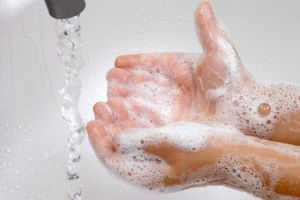
 Since the developments and the preventive measures being taken to prevent infection with the coronavirus, a great deal of emphasis has rightly been placed on washing hands. Many people are convinced that they wash their hands properly. However, when you wash your hands, there are still a number of practical points to follow. These rules also apply to intestinal disorders and infections with parasites and bacteria.
Points to consider:
- Take care when using a soap dispenser. It is touched with dirty hands and then used again by someone else. So make sure you also clean the dispenser properly.
- After washing, dry your hands with paper towels and then throw them away. Do not use a towel that is also used by other people.
- After washing your hands, do not touch the tap again; turn it off using paper towels and throw these away as well.
- Do not touch the toilet door handle with your bare hand; use paper towels again. The same applies to the light switch.
- Also keep frequently touched surfaces clean, such as the table, chair arms, kitchen handles, etc.
- Keep your mobile phone and the keyboard of your computer or laptop clean.
- Avoid unprotected contact with shopping trolleys. Disinfect the handle and wash your hands as soon as possible after shopping.
- Take care when using toothpaste, as the toothbrush touches the toothpaste. If several people use the same tube, one option is for everyone to have their own tube, or to squeeze the toothpaste out, for example onto a finger (of a clean hand), and then apply it to the toothbrush.
References:
- Environ Health. 2009 Sep;72(2):24-8. Surgeoner BV, University students’ hand hygiene practice during a gastrointestinal outbreak in residence: what they say they do and what they actually do.
- Eur J Public Health. 2011 Dec;19(4):222-6. Ergin A, Evaluation of students’ social hand washing knowledge, practices, and skills in a university setting.
- Appl Environ Microbiol. 2011 May;77(9):2898-904. Zapka CA, Bacterial hand contamination and transfer after use of contaminated bulk-soap-refillable dispensers. Soap dispensers become contaminated with bacteria and viruses and can transfer these to the hands.
- J Dent Educ. 2010 Oct;74(10):1153-8. Singh S, Mobile phone hygiene: potential risks posed by use in the clinics of an Indian dental school. Of the dental students, 64% never clean their phone, while 34% of the phones contain harmful organisms.