- The articles published on the Darmklachten.nl website were written by Saskia van As. She is a BIG-registered physician and a member of the physicians’ association AVIG.
- The purpose of the articles is to provide insight and background information about the various stool tests offered on the Darmklachten.nl website.
- The analyses are carried out in the MGlab@Advies laboratory.
- The staff of Darmklachten.nl advise you to always discuss the results with your own healthcare provider.
- If intestinal parasites or the bacterium Helicobacter pylori have been detected, it is essential that the results are passed on to the treating (general) practitioner so that treatment can be started. These analyses can also be requested by a GP or specialist.
- The result of a gut flora analysis or a histamine intolerance test is best discussed with a healthcare provider who has a naturopathic practice.
- No treatments or therapeutic advice are provided.
What is a high-fibre diet?
Good health starts in the abdomen, with the intestines. It is therefore important to get enough fibre every day. But what is fibre and what is a high-fibre diet? What can you eat and what should you avoid?
Fibre in our diet
Our diet is made up of fats, proteins and starch. These essential nutrients consist of long chains of molecules. In the small intestine there are enzymes – produced by the pancreas – that break food down into molecules. These small components can then be absorbed through the intestinal wall. There are also components that cannot be broken down properly, especially fibre. Both whole-grain products and vegetables contain fibre and can therefore be part of a high-fibre diet. Hemicellulose and cellulose are fibre structures that are not broken down well by human enzymes. These undigested food components reach the large intestine, where they have an important function. Enormous numbers of beneficial bacteria are present in the large intestine; they have many types of enzymes with which they can convert food residues into useful substances.

The right foods and fibre in a high-fibre diet
Fibre is important for a healthy intestine, so a high-fibre diet is strongly recommended! Doctors regularly prescribe fibre preparations with the aim of speeding up intestinal transit, particularly in people who are somewhat constipated. Those fibres often come from seeds, such as psyllium seed. The intention is not to take extra fibre supplements; it is important to eat a diet rich in fibre. The fibre in vegetables is very beneficial for the intestine – more beneficial than fibre from seeds. The fibre in vegetables can be processed by the beneficial bacteria present in the intestine. When you eat whole grains, you do get fibre, but also starch. Grain fibres have a different composition and may increase the numbers of bacteria that are less beneficial. Another disadvantage is that whole grains contain a great deal of starch. The glucose molecules released in the intestine disrupt the environment.
Starch and cellulose
Starch and cellulose are both made up of glucose molecules. They belong to the carbohydrates. Nowadays the term low-carbohydrate is often used for this. A low-carbohydrate diet essentially means an eating pattern low in starch and sugar. There are different types of carbohydrates, including fibre. It has been proven that you do in fact need healthy carbohydrates. Beneficial carbohydrates are found in the fibre of vegetables, in cartilage used to make broth and, for example, seaweed, which is rich in the right carbohydrates. Cellulose cannot be digested by humans, but it is an important source of calories for our gut bacteria.
What do seeds do?
In fact, humans have only recently begun eating large amounts of seeds, nuts and grains. In nature, a plant produces seeds only once a year. Through monocultures and supermarket food, large quantities of these products are now available. Seeds are reproductive products that are actually intended to become plants again. Grains store starch. Seeds and nuts contain a lot of fat. The starch, together with protein and fat, is intended as reserve food for the seed itself. In spring, the germ of the grain or seed begins to grow. By first absorbing water, the grain swells. During germination, the starch is converted into glucose as an energy source for the plant. This is how the sprout develops.
Digesting starchy products
Grains consist of 50 to 65% glucose. Humans are naturally plant eaters. We ate many tubers. Grains came onto the menu much later. Grains produce only one harvest per year. Agriculture is relatively new. Because of a high grain intake, and therefore the consumption of bread, pasta, oatmeal and rice, many people in today’s society experience problems. Excess starch is converted into fats, causing blood triglycerides to rise. The fats are stored as abdominal fat and cause obesity in very many people and increase the risk of cardiovascular disease.
Mouth and intestine
Leafy vegetables contain only 1% glucose. Tubers, such as beetroot and parsnip, contain starch, but only around 8%. In prehistoric times, humans therefore did eat tubers. But at that time these crops were not available all year round as they are today. The fact that starchy products naturally belong in our diet is shown by the fact that we produce amylase in the mouth and intestine. Amylase is the enzyme that breaks down starch. Already in the saliva, part of the starch is processed into smaller sugars such as maltose and glucose. The pancreas also produces amylase. The sugars released in the intestine are absorbed into the blood through the wall of the small intestine. They provide energy and are partly converted into fats, particularly triglycerides.
Difference between starch and cellulose
Starch consists of very long chains of glucose molecules. It is a quirk of nature that cellulose, which cannot be digested by humans, is also made up of glucose molecules. The structures of starch and cellulose are very similar:
They contain the same glucose molecules, but the difference lies in the arrangement of the molecules; they are bonded differently. The molecules in starch contain bonds that are broken down by the enzyme amylase. The glucose molecules in cellulose have a so-called beta-1,4 bond that cannot be broken down by amylase, which is present in saliva and the small intestine. Cellulose can be broken down by the enzyme cellulase. But humans do not have this cellulase enzyme. You might therefore think that plant fibres rich in cellulose do not release sugars and therefore provide no calories.
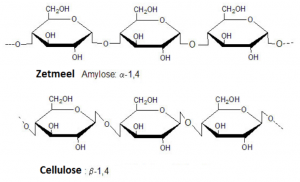
Starch and cellulose
Cellulose
Nevertheless, fibre is digested in our intestine. This is because we have many bacteria in the intestine that do have enzymes capable of breaking fibre down. The bacteria in the large intestine produce enzymes such as cellulase. Breakdown releases glucose molecules, which are then converted into so-called ‘short-chain’ fatty acids. These are beneficial fats that protect you against disease. Plant fibre is therefore very important for our health, both because it forms beneficial fatty acids and because it feeds the gut flora.
Fatty acids
In the intestine, the indigestible parts of vegetables are converted by bacteria into fatty acids such as acetic acid, propionic acid and butyric acid. Butyric acid is a substance that is very important for our health. These fats are anti-inflammatory, nourish the intestinal wall and provide a source of calories for humans. Allergic children produce less butyric acid; it is important that they eat plenty of vegetables.
What should I eat on a high-fibre diet?
It is therefore important to eat plenty of vegetables to get enough fibre and to limit your intake of starch. Try to eat 1 kilogram of vegetables a day. For example, 150 grams of leafy vegetables three times a day, as well as root vegetables every day, such as beetroot, parsnips, carrots or sweet potatoes. In effect, you replace grains with vegetables. For breakfast, for example, have a vegetable omelette or a smoothie. At lunch, have a meal salad with soup containing vegetables. Make sure there is good variety at dinner. Use vegetables in soup and stir-fry your dishes. Although potatoes do not have a high fibre content, you can use them to make a tasty vegetable mash so that you still get enough fibre. Make a good combination of vegetables with proteins such as fish, chicken or meat.

About Darmklachten.nl
Darmklachten.nl is an initiative of MGlab&Advies B.V., a laboratory specialising in stool testing. …read more